Artificial Intelligence (AI) has gone from being a futuristic idea to becoming a reality in our daily lives, weaving itself silently and sometimes imperceptibly into the fabric of our society. From Netflix recommendations that seem to predict our tastes to the algorithm that organizes the news that reaches our cell phones, AI is everywhere. However, its rapid advancement and constant media coverage, often focused on science fiction scenarios, generate as much fascination as it does doubt and fear. After all, what is AI, and what do we really need to know to understand it?
Artificial Intelligence: What Do We Really Need to Know?
But what is Artificial Intelligence?
Essentially, AI is the ability of a computer system to mimic human intelligence to perform tasks such as learning from experience, solving problems, or making decisions autonomously. Contrary to what many Hollywood films suggest, most current AI lacks consciousness, feelings, or ambitions for global dominance. Its primary function is to process and analyze vast volumes of data—an impossible task for any human—to identify patterns and optimize complex processes. In healthcare, for example, AI is a powerful tool that helps doctors analyze imaging tests, such as MRIs or CT scans, with a precision and speed that allows them to detect diseases in their early stages, or even accelerate the research and development of new drugs. In science and research, AI enables scientists to test hypotheses and analyze data exponentially faster, unraveling mysteries in fields ranging from astronomy to biology. In our daily lives, AI manifests itself in situations as routine as the voice assistants on our cell phones, the spam filters that protect our email inboxes, or the product suggestions we receive when shopping online. These are all ways in which technology works behind the scenes to make our lives more efficient.
The Myths of Artificial Intelligence
Despite its usefulness, AI fuels many myths. One of the most persistent is that "AI will steal all the jobs." This idea, while frightening, doesn't reflect the reality of technological development. History shows us that with automation comes new opportunities and the need for new skills. AI is more likely to automate routine and repetitive tasks, freeing professionals to focus on more strategic, creative, and human aspects. For example, while AI can generate drafts of text, an editor or writer will always be needed to polish, give soul, and context to the content. Along with this, the development and management of AI systems are creating a whole new range of professions. Another myth, popularized by fiction, is that "AI is conscious and will revolt against humanity." Currently, most AI systems are designed for very specific tasks and lack the capacity for consciousness, emotions, or a will to revolt. The real and more pertinent concern is not a machine revolt, but rather how this powerful technology is used. It is crucial to ensure that AI tools are developed and regulated ethically, so that they do not amplify bias or are used irresponsibly, and so that they serve the well-being of society rather than its harm.
Is Artificial Intelligence a Technological Advance?
Artificial Intelligence is undoubtedly one of the greatest technological revolutions of our time. Its impact on society will largely depend on how we manage and direct it. It's not about impeding its advancement, but about shaping it to serve a more just, efficient, and prosperous future for all. To achieve this, it's essential that our society critically inform itself, seeking news from reliable sources and articles that clearly explain AI. Knowledge of its basic principles is no longer just for scientists or engineers; it's a necessity for everyone to understand its impact and adapt to an ever-changing job market.
Finally, the debate over the ethics of AI is one of the most important of our time. As a society, we need to actively participate in the discussion and define the rules for the use of this technology, ensuring that it is a tool that enhances our humanity, not a force that diminishes it. By understanding its true potential and dispelling the myths, we can embrace a future in which technology works for us.
Artificial Intelligence: What Do We Really Need to Know?
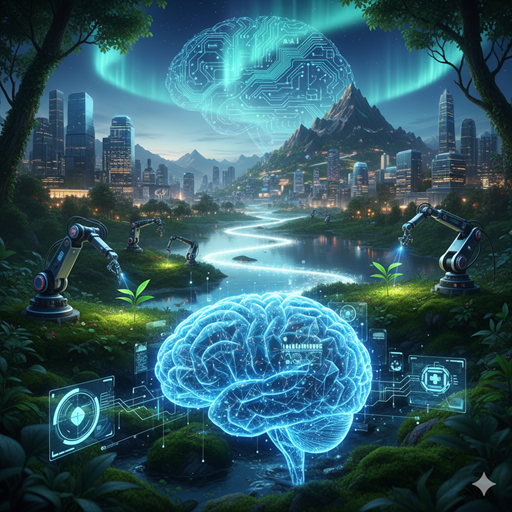
(The images in this article were generated by AI)
1 - What is Artificial Intelligence and how is it already part of our daily lives?
Artificial Intelligence (AI) is the ability of a computer system to mimic human intelligence to learn, solve problems, and make decisions. It is silently present in everyday situations: in Netflix movie recommendations, email spam filters, mobile phone voice assistants, and even in medicine, where it helps doctors detect diseases early through rapid analysis of tests. Its main function is to process vast volumes of data to optimize processes and make our lives more efficient.
2 - Will Artificial Intelligence steal all jobs or develop self-awareness?
These are two of the biggest myths about AI. Historically, automation creates new opportunities and skills; AI should automate repetitive tasks, freeing humans for more strategic and creative roles. As for consciousness, current AI does not possess feelings or free will; it is designed for specific tasks. The real concern should not be a "machine uprising," but rather how the technology is used, ensuring that its development is ethically regulated to serve the well-being of society.
3 - Why is it important to understand how AI works today?
Understanding the basic principles of AI has become a necessity for everyone, not just scientists. Critically informed thinking allows us to understand the impact of AI on the job market and actively participate in the debate on technological ethics. The goal is not to impede its advancement, but to shape it so that AI becomes a tool that empowers our humanity and contributes to a more just and prosperous future, ensuring that technology always works in our favor.