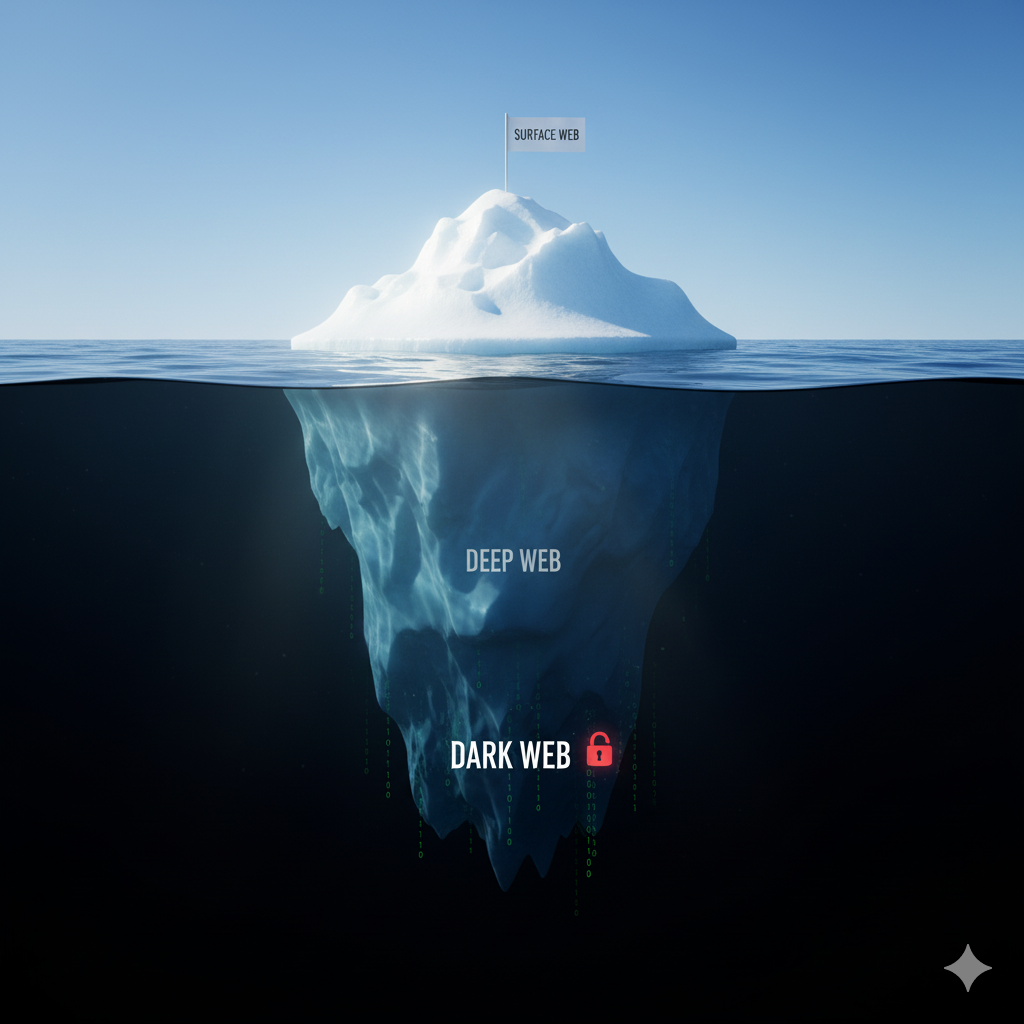
The internet is a vast digital universe, but most of us only interact with a small part of it. What we use daily is just the tip of the iceberg. Beneath the surface lie vast and complex layers, often poorly understood.
Terms like Deep Web and Dark Web generate fear and confusion, but the truth is that their natures are very different. In this article, we'll demystify the internet and explain, in simple terms, what each of its layers really means.
Deep Web and Dark Web: Demystifying the Internet.
The Surface Web: The Tip of the Iceberg
The Surface Web is the layer we all know. It's the universe of the internet that's visible and indexed by search engines like Google, Bing, and Yahoo.
What is that?
Public websites, blogs, news portals, online stores, social networks (where profiles are public), and any page that can be found with a simple search. This is the part of the internet that literally "floats" on the surface, ready to be discovered by everyone.
How does it work?
Search engines use programs called crawlers (automated programs, also known as robots, bots, or spiders, that systematically traverse the internet, gathering and indexing information from web pages) to crawl millions of pages, cataloging their content. Thanks to this process, information becomes easily accessible. However, this layer represents only about 5% of the entire internet.
The Deep Web: The Invisible and Harmless Giant
The Deep Web is the largest part of the internet, and its name refers to all content that isn't indexed by search engines. That's why it's impossible to find with a traditional search.
What is that?
The vast majority of the Deep Web is safe, normal, and used by all of us daily. It includes everything that requires a credential, password, or exists only in dynamic databases, such as:
Email boxes (Gmail, Outlook).
Internet banking profiles and credit card accounts.
Login-protected pages on streaming platforms like Netflix and Spotify.
Databases of companies, universities and hospitals.
Cloud documents (Google Drive, Dropbox) and website control panels.
How does it work?
The purpose of the Deep Web is privacy and security. Information is only available to the right people, through login, without being visible to the rest of the world. The Deep Web is not a dangerous place; it's simply the part of the internet that requires secure and restricted access.
The Library Analogy

To understand better, imagine the internet as a vast library:
The Surface Web is the public catalog. It lists all the books available on the main shelves.
The Deep Web is made up of all the books on the shelves but not in the public catalog. To find them, we need to know exactly where they are or have special authorization (a card, for example).
The Dark Web is a secret room, a basement deep within the library. There's no catalog, you can only enter with a special key, and what's inside isn't accessible to most people.
The Dark Web: The Secret and Dangerous Little Layer
The Dark Web is a tiny portion of the Deep Web. Access requires specific software, the most well-known being Tor (The Onion Router).
What is that?
The Dark Web was created to offer near-total anonymity. Its dual nature makes it used by journalists and activists who need to communicate securely, but also by criminals. It's a haven for illicit activities, such as the sale of drugs, weapons, and stolen data.
How does it work?
The Tor browser doesn't connect your computer directly to a website. Instead, it routes your traffic through a series of random servers, adding layers of encryption (that "onion"). Each server removes a layer, making it as difficult as possible to trace the user's identity or location. It's precisely this nature that makes the Dark Web such a breeding ground for criminal activity.
Safety and Conclusion: Surf with Confidence
The main conclusion to be drawn is simple: the Deep Web is normal and safe; the Dark Web is dangerous and should be avoided.
Knowing the difference between the two is the first step to safe browsing and understanding the digital world. Cybersecurity isn't just a technical term; it's everyone's responsibility. To protect yourself online, remember these basic tips:
Use unique and strong passwords.
Do not click on suspicious links you receive via email or in messages.
Keep your antivirus and operating system up to date.
Use sites that have an SSL certificate (https://).
At Living Place, your online security is a priority. We hope this article helps you navigate the internet with more confidence and knowledge. If you have any further questions or need help protecting your digital presence, don't hesitate to contact us.
Deep Web and Dark Web: Demystifying the Internet.
(The images in this article were generated by AI)
1 – What is the main difference between the Surface Web, Deep Web, and Dark Web?
The Surface Web is the visible layer indexed by search engines, representing only 5% of the internet. The Deep Web is the "invisible giant" containing unindexed content, such as emails and bank accounts, and is essential for our daily privacy and security. The Dark Web, on the other hand, is a small portion of the Deep Web that requires specific software (such as Tor) for access, focusing on total anonymity, which makes it prone to both activism and illicit practices.
2 - Is it dangerous to use the Deep Web in my daily life?
No, the Deep Web is not a dangerous place; on the contrary, it's a part of the internet we use every day to protect our personal information. Whenever you access your email, check your online banking, or log into your Netflix account, you are browsing the Deep Web. Its fundamental purpose is to ensure that sensitive data is only available to authorized individuals through secure credentials, without being publicly exposed in search engines.
3 - How can I ensure my safety and cybersecurity while browsing the internet?
Cybersecurity is a shared responsibility and begins with basic protection practices. To browse with confidence, you should use unique and strong passwords, avoid clicking on suspicious links, and keep your antivirus and operating system always up to date. In addition, always check if websites have an SSL certificate (https://). Understanding the difference between the layers of the internet is the first step to avoiding risk zones, such as the Dark Web, and protecting your digital presence.